New apocalypse tour stop!

Can’t make it to London or Oshawa? Good news! The YA apocalypse tour will also be coming to the Barrie area. Leah Bobet, Maureen McGowan, Cheryl Rainfield, and I will be at the Essa Public Library in Angus on Thursday May 2nd from 4pm to 5:30pm, along with special guest Adrienne Kress. We’ll be having a panel discussion and Q&A, and books will be sold and signed!

RSVP on Facebook here!

Apocalypse Tour Pt. 2: The Mayans Got It Wrong

Patient blog readers, I have good news for you! You may remember a while back I got together with some other awesome Ontario YA post apocalyptic/dystopian authors and did a little tour? And then asked where you all would like to see us next if possible? Well, we can finally announce that we are hitting the road again!

On Saturday May 4th, from 2pm to 5pm, you can find me, Leah Bobet, Maureen McGowan, and Cheryl Rainfield at Chapters London, where we will be chatting about YA and apocalypses and dystopias and whatever else you’re interested in, as well as signing books and offering swag, of course. Facebook event page if you want to RSVP here.

On Sunday May 5th, from 2pm to 5pm, you can find me, Maureen McGowan, Cheryl Rainfield, and Courtney Summers at Chapters Oshawa, where we will be doing more of the same! Facebook event page if you want to RSVP here.

We are also in the process of setting up an event near Barrie, and possibly another Toronto one, which we will update you on as details become available.

Apologies to the Ottawa folks — we really wanted to make it out there, but our schedules just were not lining up to make that happen. And sadly Lesley Livingston is not able to join the tour this time around due to bookish commitments. Just remember that means we’re writing so that you can get more stories from us! Perhaps we can make it work next year. 🙂

Ontario readers and book fans: feel free to share the news and/or this post far and wide!

On getting feedback as a writer, or You can’t win

I wrote a post a couple weeks ago for readers on one aspect of offering feedback to writers, and that got me thinking about what I’d most want to say to my fellow writers — currently published or aspiring — on the subject of suggestions and criticism.

Getting critical feedback on one’s writing is one of the hardest parts of any creative career. In how many other jobs are you are expected to hear what you’ve done wrong and how you can do it better with every step in every piece of work? But it’s a necessary discomfort. We need outside feedback to make sure our stories are as good as they can be. The story in our head is never going to make it perfectly onto the page, and that story in our head can stop us from seeing clearly what really is on the page. Hearing from others what they see allows us correct weaknesses and errors that escaped our notice, and to adjust and revise so that we’re getting across the story we wanted to tell as accurately as possible.

To me, that last part is what’s most important. Sometimes, yes, you’ll realize that an element a story isn’t actually as strong as you thought, or you need to take your characters in a different direction than you originally intended to avoid a plot hole, or you’ve unintentionally included content that’s problematic, all of which you’ll want to address. But ultimately the best thing you can do is focus on that story you want to tell. Writing and revising can’t be about pleasing others. That’s the lesson I wish I’d learned sooner:

You can’t win.

You are never going to write a story so wonderful and flaw-free that everyone in the world adores it, or even likes it reasonably well. No such story exists. What’s the best-crafted book you can think of? What’s the most innocuous? Look them up GoodReads and if they have at least a couple dozen reviews, I guarantee there’ll be someone harshly criticizing them.

And it isn’t even a matter of perfection being just out of reach, if only you’d thought of X or done Y, you’d be okay. One of the first things you’ll notice (or will have noticed) when you offer your creative work to the world is that not only will there inevitably be people who are critical of it, the criticism you get from different sources will inevitably clash. Someone will say the pacing is too slow, and others will say it moves too quickly. Someone will find it too complex and others too shallow. Some will see this character as too selfish and others as too selfless. And so on. At this point I honestly believe that any criticism that can be leveled at a story, at some point there is someone who will make it at this story.

You can’t please everyone — it’s impossible, when your audience is made up of people with a huge variety of often-conflicting backgrounds, interests, and perspectives. You can’t win. At least not at that game.

You could see that idea depressing. But to me, and this is why I wanted to share it, it’s freeing. Once you accept that you can’t win, you can let go of trying to. Step away from the “game” of trying to please every editor, every critique partner, every reader. And let yourself delve into what really matters to you about whatever you’re working on. Write and revise not as an attempt to eliminate every hint of anything anyone might criticize, but to bolster the parts of the story that you feel are worth celebrating.

I think you’ll find that not only are you happier, but your work will be better for it. Stories aren’t loved for what they avoid doing, but for what they do. Read a few ecstatic reviews from readers of a popular book or series, and you’ll know that people can absolutely adore something no matter how many problems they notice it has. Make people think and feel, give them an experience that affects them, and that’ll matter more to them than almost any flaw.

So the advice I’d most want to give every writer is this: Make sure you’re telling the story you want to tell, and then tell that story with all the passion and conviction you have in you. You won’t win with everyone, but no one does. When you accept that, you won’t really be losing either.

The music of The Lives We Lost – “Our Hell”

Keeping up the tradition of discussing the unofficial soundtracks of my books after the release! Be warned: these posts may contain vague spoilers for The Lives We Lost.

The first song on my unofficial soundtrack for the second book in the Fallen World trilogy is “Our Hell” by Emily Haines and the Soft Skeleton:

For whatever reason, Emily Haines’ solo music seems to fit the trilogy perfectly. I consider one of her songs the theme song of The Way We Fall, and “Our Hell” captures a lot of the tensions in its sequel.

There’s Haines’ haunting voice that easily evokes the desolation Kaelyn faces in the changed world of The Lives We Lost, and the march-like beat that echoes the long journey ahead of the group. And the lyrics… The title line, “Our hell is a good life”, could refer to both the survivors making the best of the awful situation they’re in, and those who cling to what security they have left, refusing to take further risks even though things could get much worse if they don’t. The repeated chorus of “What I thought it was it isn’t now” reminds me of the discoveries Kaelyn makes along the way, and on a more metaphorical level, of her realization that her dream of restoring the world to the way it once was may be impossible. Those who have read the book can imagine how mentions of being “on the road”, and knowing “what to forget, how to do right” relate to certain events.

But most affecting to me is the very last verse, which could almost be a reflection of the last few chapters: “There’s a pattern in the system/There’s a bullet in the gun/That’s why I tried to save you/But it can’t be done/It can’t be done.”

Book 3 news and more!

I thought you all might be interested to know that Jessica at Read My Breath Away is doing a Megan Crewe week right now. And that includes a very special post in which I give the first bits of information about what will happen in the final book in the trilogy.

So stop by to read some tidbits about The Worlds We Make.

And you can also enter to win a copy of The Way We Fall if you’d like!

On publishing timelines and reader feedback

Every so often I’m reminded that things that have started to seem natural, now that I’ve been enmeshed in the publishing industry for some time, are not actually obvious, or even seemingly sensical, to the average reader. So I thought I’d talk a little about publishing timelines. And what I mean by that is…

How long does it take a book to make it into stores?

If you follow your favorite authors at all closely, you’ve probably noticed that books tend to be announced way in advance of when they’re actually available to buy. Possibly you’ve assumed those books are just not finished being written yet, or are going through massive revisions, and they get sent to the printers pretty much as soon as they’re ready to go.

Not so. In my experience, and the experience of every other author I know releasing novels with a large or mid-sized traditional publisher*, the norm is for the final version of the manuscript — written and revised and finished all passes with the primary editor — to be due approximately one year before the intended release date. And if it’s not close to ready that one year in advance, the release date gets pushed back. I was asked to finish my last round of revisions on Give Up the Ghost by the end of August 2008; the book came out September 22, 2009. I was asked to finish my last round of revisions on The Way We Fall by the first week of January 2011; the release date was January 24, 2012.

The author still has opportunities to make changes after that point, of course. After editorial revisions come copyedits and page proofs. But the changes at those stages are intended to be minor–preferably no more than few sentences added or taken away here and there in copyedits, and preferably nothing more than error corrections and wording changes at the page proof stage, when the manuscript is already laid out for printing. Occasionally you’ll hear about someone making a major change so late in the game that the final book’s plot or characterization differs significantly from the advance reader copies (which are usually printed at the same time as page proofs, still several months before the release date), but that’s news because it’s so rare.

Also rarely there are books that get pushed through the publishing line much more quickly. This most often happens with non-fiction, when there’s a pressing topic of the hour and the publisher wants to get in there while it’s still relevant. But it does also happen occasionally with fiction, usually when the publisher ends up with an opening in their schedule and/or a book they’re really excited about and want to get out before anyone publishes something too similar. But even in the few cases with novelists I know of, the book still had to be through to the copyedits no less than six months ahead of time.

Why on earth does it take so long?

Well, not actually working for a publishing house myself, I don’t know all the details. But I can tell you that a major part of the reason is buzz. Publishers want to have lots of time for word about upcoming books to trickle out and, where possible, build with increasing excitement. And one of the major ways they get word out is through those advance reader copies (ARCs). ARCs get passed out to the sorts of folks who talk up books (librarians, journalists, other writers) at industry conferences and conventions, they’re sent to magazines and blogs for review and to bookstores to encourage stocking the books.
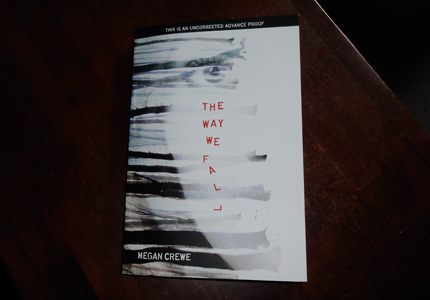

(My first ARC for The Way We Fall)

Printing and distribution and then reading of those ARCs takes a fair bit of time. Publishers generally want to start offering them about six months before the release date (often even earlier–ARCs for Ghost arrived in March 2009 and for TWWF in May 2011), which means the manuscript needs to be typeset and sent to the printer well before then. And publishers prefer to put the book forward in as polished a state as possible, so they want copyedits done by that time. Which means the regular editorial revisions need to be done even further in advance to give the copyeditor time to look over the manuscript and the author time to go over the copyedits. In the cases where a manuscript is rushed through, what often happens is the last round of editorial revisions are done at the same time as copyedits, or copyedits at the same time as page proofs, to condense the process, but this gives the editors and authors less time to catch errors, so it’s not really ideal.

What does that mean for authors?

Authors are usually working in a somewhat staggered fashion. While promoting a book that’s just come out, we’re likely to be doing copyedits on a different book that’s on the way, and writing a totally different new book. With a series, our work is always way ahead of the reader.

When The Way We Fall appeared in stores, I had already written and finished editorial revisions on its sequel. I’d turned in the “final” (pre-copyedits and page proofs) manuscript to my editor at the beginning of January 2012. In fact, I’d already started writing book 3 at that point. The Worlds We Make has not yet gone through the last, line-editing stage of editorial revisions, mainly because there will be no ARCs printed for the last book in the trilogy so the schedule is somewhat relaxed, but I turned in my substantive edits at the beginning of this January, more than a month before The Lives We Lost was out.

The rest of Kaelyn’s story is already complete, and any further changes are going to be minor.

It can create kind of an odd feeling, to be talking to readers excited about the first book in a trilogy and have to remind yourself they don’t know the rest of the story that you’ve already written (and pretend you don’t already know everything that’s going to happen lest you give away spoilers).

What does that mean for readers?

Mainly it means, for better or for worse, the thoughts you share with authors on their books can have very little impact on the books themselves or the rest of the series.

Even if you get your hands on an ARC and read it immediately, by that time page proofs have probably been finished and the book is out of the author’s hands. And if you’re reading a book close to or after its release date, it’s very likely the text of any sequel is close to being finalized. Even if an author wanted to adjust something in a story to meet reader requests (which you have to realize is asking a lot as it is, given that we tend to get requests for completely opposite things on a regular basis, and of course we usually have pretty strong feelings about what story we want to tell), it’s generally impossible.

Every author I know still loves to hear from readers. Knowing what you loved about a book, especially if it’s what we loved about writing that book, is incredibly gratifying. Knowing what you didn’t like, even if we can’t make direct use of that info, can sometimes give us ideas on how to approach later projects. But sometimes I see readers commenting that they feel an author isn’t listening, or listened too much to the wrong responses, and I can tell you it really isn’t about that. The way publishing works, the choices we make for our stories have to be our own. Which is probably the way it should be, because that’s our job after all. And I have say, as a reader, I find the best twists and turns a story can take are ones I never would have thought of myself.

*Publishing timelines with self-publishing of course vary quite a bit from this–mainly because people self publishing tend not to announce books until they’re pretty close to releasing them. I assume they vary with small publishing houses as well; I don’t have a lot of experience there.

The hardest things to lose

Over at TeenReads today, I’m sharing the three things I’d most hate to lose if the world fell apart the way it does in the Fallen World trilogy:

The title of my newest book, The Lives We Lost, doesn’t just refer to the loved ones the main characters and her friends have lost to the epidemic. It’s also about the loss of their way of life: all the facets of the modern world they took for granted, which are no longer possible when society has been reduced to small pockets of survivors.

Which has made me wonder, what parts of the life I take for granted would I miss the most in the same situation? Many aspects would be difficult for anyone — going without electricity, having to scrounge for food and sources of heat, deciding who to trust — and of course there are lots of luxuries I’d miss, but what would hit me personally the hardest?

Continued at the site

If you have a moment, stop by and share what you’d find most difficult to give up!

Street Team winners!

The points have been tallied up and the winners discovered and drawn. I’m pleased to announce the winners of the Fallen World street team giveaway!

With the highest number of points earned, the first two winners were…

Karis Cole
Jessica Reid

And through random draw, we have two more winners…

Heather @ BookStacksOnDeck
Jen Kentfield

Huge congrats to the four of you! And huge thanks to all the street team members who participated! If you hadn’t already received your street team swag pack with a requested shirt or set of bookmarks, I’ll be mailing that off to you shortly.

Don’t worry, Fallen World fans who weren’t able to get in on the street team action before. You’re still welcome to join, and there’s more fun to come! In fact, I already have plans for a new street-team only giveaway to be starting soon… Info on how to join can be found here.

Book 3 title and (sort of) cover reveal!

My publisher’s catalog for next winter has gone live, which means I get to share with you a little info about Fallen World book 3 very early! To begin with, I’m very pleased to announce that the title of the third book in the trilogy is….

The Worlds We Make

I’m so happy I got to keep this title — it’s the title I was using for the sequel to The Way We Fall back before that sequel had to be split in two, and I think it captures the end of the story perfectly.

And not only that, but I’ve been given permission to share the preliminary version of The Worlds We Make‘s cover! Now, this cover isn’t finalized and may still undergo some tweaking, which is why it has that Cover Not Final watermark. But I think you can get a pretty good idea.

Drum roll, please!

.
.
.
.
.
.
.
.

I love how the colors are going to work with the yellow of The Way We Fall and the blue of The Lives We Lost!

There you have it! What do you think of the title and the cover? 🙂

Me around the ‘net, Pt. 2

And the blog tour continues! Here’s where I’ve been talking about The Lives We Lost in the past week:

-At YA Bookmark, I revealed three things that were cut from the final version of the book (with excerpts).

-I gave Midnight Bloom Reads my best tips for surviving an epidemic — and she’s giving away both The Way We Fall and The Lives We Lost!

-I shared my favorite journey stories with Geek Girl’s Book Blog.

-For I’d So Rather Be Reading, I showed how alike Kaelyn and I are.

-And I answered Conversations of a Reading Addict’s questions about the dystopian genre, Leo, and other more.